 Menu
Menu
As I’ve been testing various Oculus Rift demos to prepare for our first virtual reality prototype, I noticed that one of the many differences with development for games for regular screens, is that you can’t show the same amount of information and text on the screen.
This limitation is mainly due to the low display resolution of the developer version of the Oculus Rift. These limitations remind me of my time developing for the Nintendo Wii – where working with standard-definition TVs meant having to support a worst-case resolution of 640×480.
The Oculus Rift DK1 (the first and at the time of writing only Development Kit), works with 640×800 per eye. And in fact, it’s worse than standard-definition TV: only 73% of the screen’s pixels are actually used, and the ones in the center are perceived bigger due to the lenses required for the Rift’s impressive viewing angle.
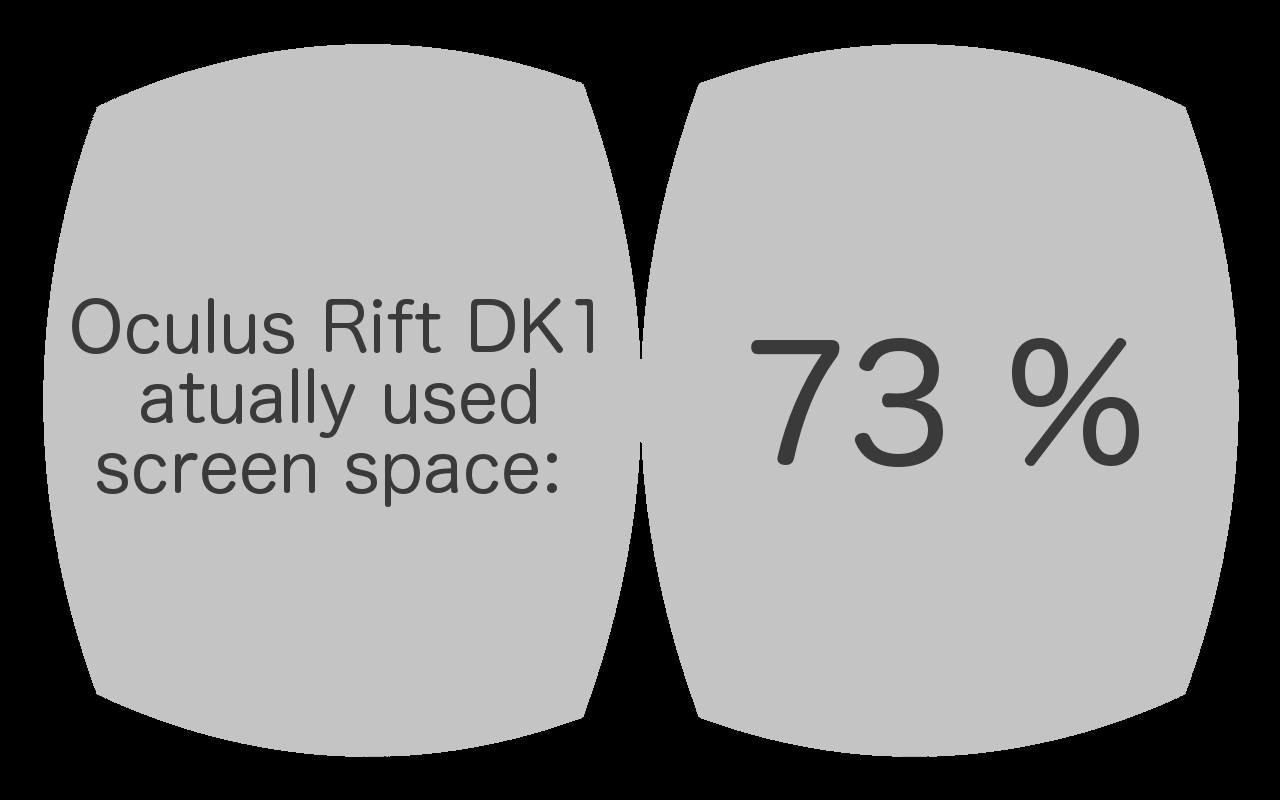
73.34% of the pixels are actually used by the Oculus Rift DK1 (751035 out of the 1024000 pixels, to be exactly).
While discussing these limitations with our client, he simply replied:
Don’t worry about the text limitation by the current Oculus Rift. What we will build for, is the 4K version.
At first I thought having a 4K resolution (3840×2160, or 1920×2160 per eye) in a VR device would be only be possible in many years from now, because it would require such a high pixel density.
After doing some math, I was surprised that a 4K resolution Oculus Rift would be feasible with current technology:
- The screen size of the Oculus Rift DK1 is roughly 6.69×4.65 inch (measured on the outside), or 8.15 inch diagonally.
- The Rift’s 1280×800 resolution has a diagonal of 1509.44 pixels, resulting in a pixel density of 185 pixels per inch (ppi).
- A 4K resolution (with a diagonal of 4405.81 pixels) at this size would need to have a whopping pixel density of 540 ppi.
- The highest resolution iPads and iPhones have a pixel density of 326 ppi (60% of what would be needed for a 4K Rift).
- Looking at Wikipedia’s List of displays by pixel density, we learn that the HTC One, on the market since March 2013, has a 1920×1080 screen with a 468 ppi density. According to the same Wikipedia article, the Chinese electronics manufacturer Oppo Electronics would have a 2560×1440 screen in development of 538 ppi (rumoured to be on the market somewhere in 2014).
- A 1920×1080 screen at almost the right density doesn’t mean that a 4K resolution at this density would be possible. A few Google searches later, I found that Samsung would be working on phones with a 4K resolution and 560 ppi.
At first I was very sceptical about the low resolution of the Rift, but a bit of math later, I’m actually convinced this is technically feasible.
Whether the first consumer version of the Oculus Rift would be shipped with a 4K resolution screen is rather doubtful though, as Oculus’ Palmer Lucky stated that a 4K version would not be in development.